By URLsy Team · Infrastructure Editorial
A short link is only as good as the redirect experience behind it. If your redirect layer is slow or inconsistent, campaign traffic drops off before users even see your destination page. This guide explains the infrastructure basics marketers and growth teams should care about when evaluating redirect performance.
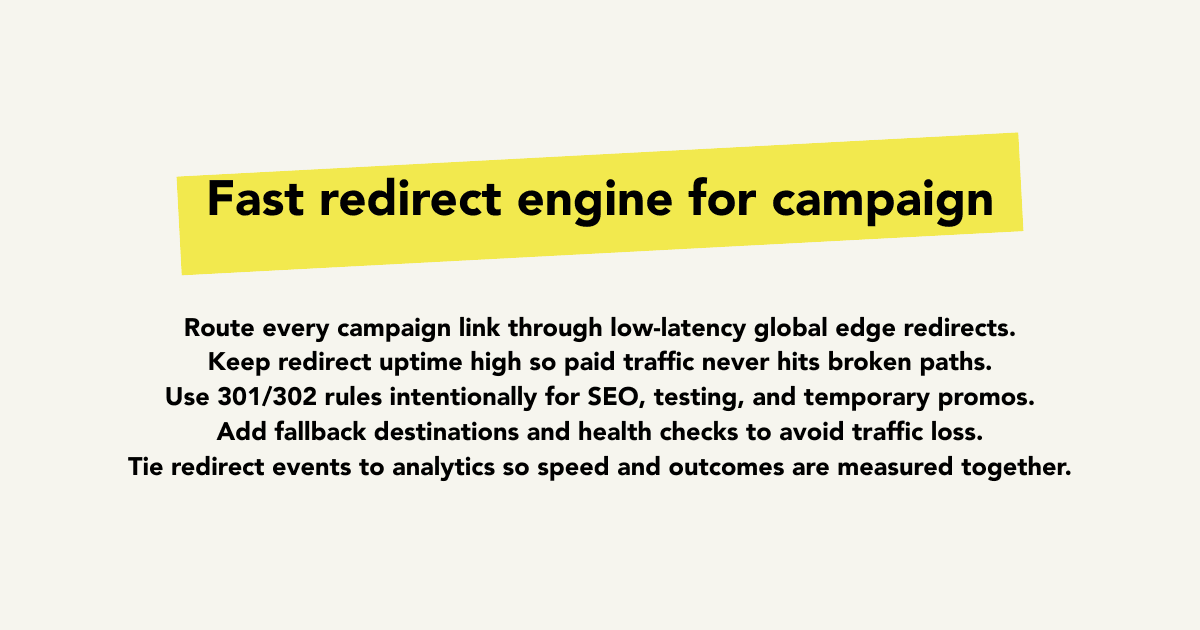
Key takeaways
- Redirect speed affects click-through completion and bounce risk.
- Reliable routing and uptime protect campaign spend during launches.
- Latency should be monitored with channel-level campaign analytics.
Why redirect speed matters before the landing page
Users experience redirect delay as friction. Even small pauses can reduce confidence, especially in paid traffic and mobile-heavy channels.
A fast redirect engine helps preserve click intent by moving users from short link to destination with minimal processing time.
For campaign teams, that translates into better delivery efficiency and cleaner interpretation of top-of-funnel performance.
Reliability is as important as low latency
Speed alone is not enough. Redirect infrastructure must stay stable under traffic spikes from launches, creator drops, and paid bursts.
When reliability fails, links may timeout or resolve inconsistently, creating hard-to-debug attribution gaps.
A dependable routing layer ensures every click reaches the intended destination and remains measurable.
How to evaluate redirect quality in real campaigns
Test links across regions, devices, and peak periods rather than relying on one benchmark result.
Track bounce patterns and landing latency together with click counts to spot where redirect overhead is hurting outcomes.
Use channel-level short links so routing issues can be isolated quickly instead of hidden in aggregate numbers.
Operational checklist for high-speed link delivery
Use one short link per campaign placement to make diagnostics and optimization straightforward.
Pair branded short links with analytics so trust and performance are reviewed together.
Set a weekly review loop for delivery quality, not just conversion outcomes, to prevent hidden performance decay.
FAQ
Does redirect speed really impact campaign results?
Yes. Slower redirects can increase abandonment before users reach the destination, especially on mobile and paid traffic.
What is more important: redirect speed or reliability?
Both matter. The best outcomes come from low-latency redirects that remain stable during high-traffic periods.
Related next steps
Fast campaign links
Launch short links built for clean delivery and trust.
Explore →Measure campaign flow
Monitor clicks and outcomes by channel and placement.
Explore →Compare workflows
Evaluate platform fit for performance-first campaign teams.
Explore →Start with URLsy
Create your first high-speed tracked link.
Explore →Call to action
Turn the strategy into tracked links
Apply these ideas with branded short links, QR codes, and analytics in one campaign workflow.